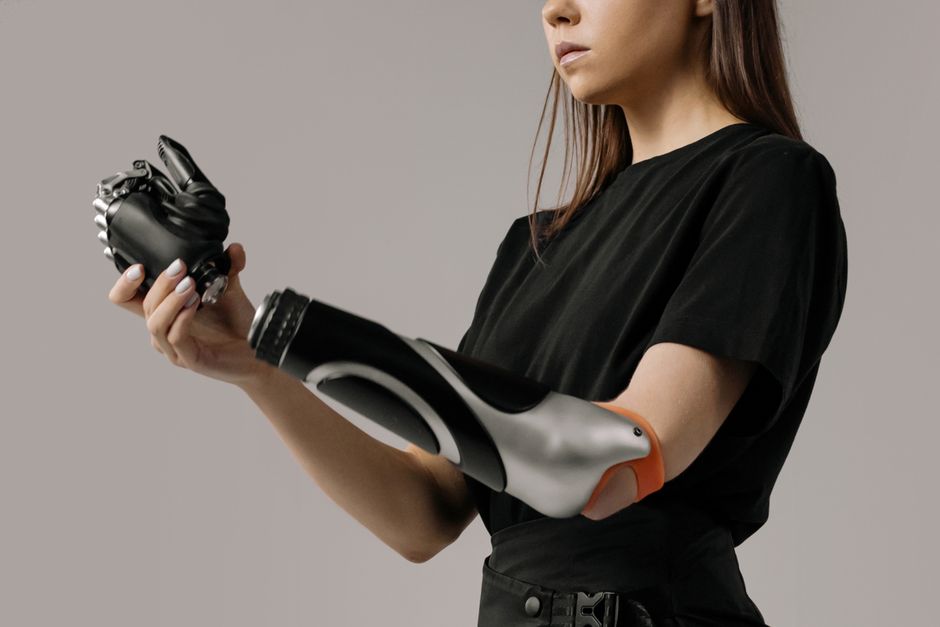
Photo via Pexels
Direct Neural Prosthetics with Bi-Directional Tactile Feedback involve implanting microelectrode arrays (e.g., Utah arrays) directly into the motor cortex for intuitive efferent control of advanced prosthetic limbs. Crucially, it also integrates peripheral nerve interfaces (e.g., targeted reinnervation or intraneural electrodes) to send afferent sensory information back to the wearer, enabling a realistic sense of touch, pressure, temperature, and proprioception from the prosthetic device. This is achieved through AI/ML algorithms that decode brain signals for motor control and encode sensory data for neural stimulation. Pioneering organizations include Battelle, Johns Hopkins University Applied Physics Lab (APL), and universities like Pittsburgh and EPFL, with companies like Blackrock Neurotech leading commercial efforts. The technology is in advanced clinical trials, with motor control well-established and tactile feedback rapidly improving. A significant milestone occurred in 2023 when Battelle and Ohio State University demonstrated a bidirectional neural interface enabling a paralyzed individual to control a prosthetic hand with thought and feel tactile sensations, achieving a 90% accuracy in object identification. This innovation dramatically improves upon traditional myoelectric prosthetics, which offer limited function and no direct sensory feedback.
Editorial check
How this page is checked
Source trail
blackrockneurotech.com
External links are separated from Surfaced commentary.
Reader safety
Context before clicks
Product links and external services are not presented as guarantees.
Monetization
No affiliate flag
Ads and commerce links are kept distinct from editorial text.
Surfaced take
Why It Matters
Over 2 million amputees in the US alone grapple with functional limitations, phantom limb pain, and a lack of proprioception, severely impacting their quality of life and independence. This technology offers up to 90% restoration of motor control and significant sensory integration, substantially reducing phantom limb pain and improving functional outcomes. When mainstream, amputees will regain the ability to perform complex tasks with dexterity, feel the warmth of a hand, and sense the texture of objects, leading to greater autonomy, reduced psychological burden, and a profound feeling of 're-embodiment.' Amputees, specialized prosthetic manufacturers (like Ottobock and Össur), and neurotech companies (e.g., Blackrock Neurotech) will be the primary beneficiaries. Main barriers include the surgical invasiveness, ensuring the long-term stability and biocompatibility of neural implants, managing infection risks, the high cost of the devices and procedures, and navigating complex regulatory approval processes. Limited clinical availability is expected within 5-10 years for specific cases, with broader commercial availability within 15-20 years, spearheaded by US and European research. A profound second-order consequence is the redefinition of human identity and body ownership, potentially paving the way for elective augmentation and entirely new forms of human-machine interaction, with significant implications for rehabilitation medicine.
Development Stage
Related

Textio
Textio is an advanced AI-powered augmented writing platform developed by Textio, Inc., designed to dramatically improve the performance and inclusivity of…

Acti
Acti is an innovative agentic keyboard for mobile devices that transforms how you interact with your smartphone. Instead of switching between apps for…
Enjoyed this? Get five picks like this every morning.
Free daily newsletter — zero spam, unsubscribe anytime.