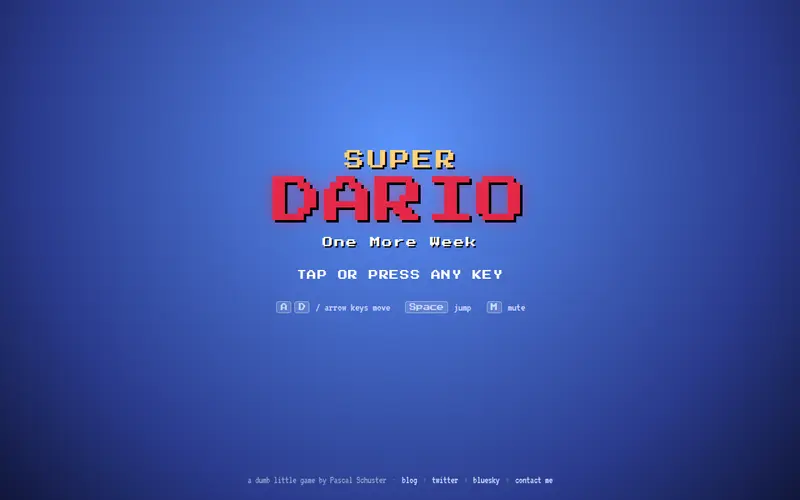
Super Dario is a minimalist personal knowledge management tool designed for individuals who want a straightforward way to organize notes, ideas, and information without the complexity of feature-rich applications. It focuses on a clean interface and efficient note-taking, allowing users to create interconnected notes and build a personal wiki or second brain. The tool is ideal for students, writers, researchers, or anyone who benefits from a structured yet uncluttered approach to managing their thoughts and findings.
Editorial check
How this page is checked
Source trail
superdario.pawb.de
External links are separated from Surfaced commentary.
Reader safety
Context before clicks
Product links and external services are not presented as guarantees.
Monetization
No affiliate flag
Ads and commerce links are kept distinct from editorial text.
Surfaced take
Why It’s Useful
In a landscape dominated by feature-heavy PKM tools, Super Dario stands out for its deliberate simplicity. It eschews the overwhelming options found in many popular alternatives, offering a focused experience that prioritizes speed and ease of use for core note-taking and linking. Power users often appreciate its lack of distraction, allowing them to dive deep into content creation and organization without getting bogged down in settings or complex markup. For those who find tools like Obsidian or Logseq too daunting, Super Dario provides a gentler on-ramp to building a connected knowledge base, making it exceptionally useful for people who value clarity and efficiency over an exhaustive feature set.
In everyday life
When you’d actually reach for this
You're jotting down ideas for a blog post while waiting in line. You need to quickly capture a recipe someone shared during a casual conversation. You want to remember the key points from an article you bookmarked to read later.







Enjoyed this? Get five picks like this every morning.
Free daily newsletter — zero spam, unsubscribe anytime.