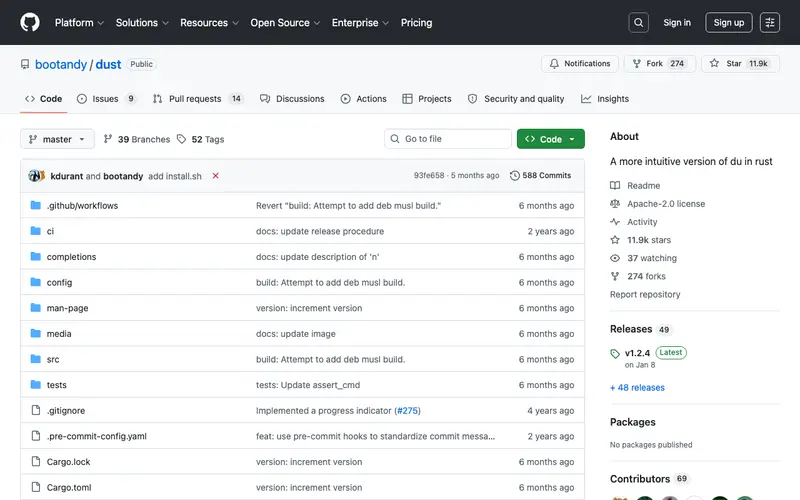
dust is an open-source command-line utility, written in Rust, that functions as a more intuitive and visually appealing replacement for the standard `du` command. Its core feature is to analyze disk space usage, presenting results in a clear, hierarchical tree view with colorization and proportional bar graphs to easily identify large files and directories. This tool is built for developers, system administrators, and users struggling with limited disk space who need to quickly understand where their storage is being consumed. You would typically run dust when your hard drive is full, and you need to pinpoint which directories are hogging the most space for cleanup. It is available across Linux, macOS, and Windows platforms.
Editorial check
How this page is checked
Source trail
github.com
External links are separated from Surfaced commentary.
Reader safety
Context before clicks
Product links and external services are not presented as guarantees.
Monetization
No affiliate flag
Ads and commerce links are kept distinct from editorial text.
Surfaced take
Why It’s Useful
dust transforms the often-monotonous task of checking disk usage into an insightful visual exploration, far surpassing `du`'s raw numerical output. For the developer running out of space in a complex project directory, dust immediately highlights large build artifacts or cache folders that can be safely removed. For the system administrator managing server storage, its clear tree view and proportional bars make identifying forgotten log files or large backups effortless. dust is completely free and open-source. A particularly useful, but often undiscovered, feature is its ability to sort by size and limit depth (`-d` or `--depth`), enabling focused analysis on specific levels of the file system hierarchy. Its niche nature and the ingrained habit of using `du` or `ncdu` contribute to its lesser popularity, despite its superior visual clarity and user experience. The project is actively maintained on GitHub, with ongoing development and community support.
In everyday life
When you’d actually reach for this
When you're trying to figure out why your home directory is suddenly full before a big software update, you'd use dust. If you're cleaning up a shared project folder before handing it off to a colleague, dust helps you quickly spot what's taking up the most space.







Enjoyed this? Get five picks like this every morning.
Free daily newsletter — zero spam, unsubscribe anytime.