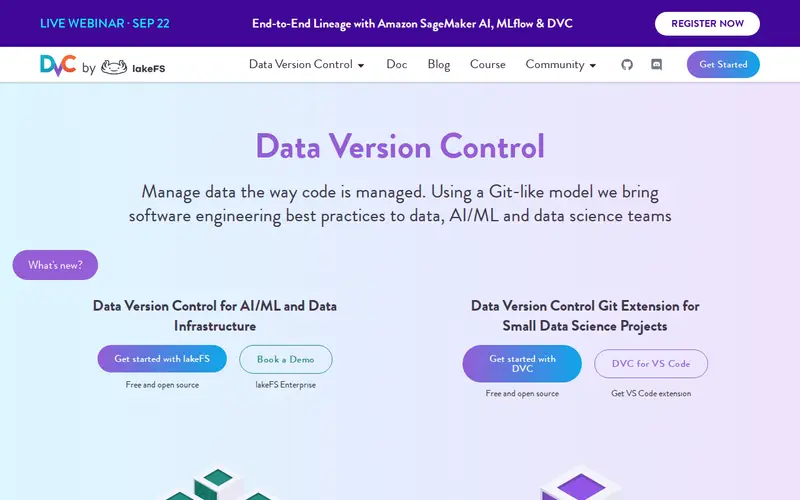
DVC (Data Version Control) is an open-source version control system for machine learning projects. It extends Git to handle large files, data sets, and machine learning models, which are not well-suited for traditional Git repositories. DVC tracks data and model versions using lightweight pointers, while the actual data is stored in external storage solutions like cloud buckets or network drives. It's free and open-source.
Editorial check
How this page is checked
Source trail
dvc.org
External links are separated from Surfaced commentary.
Reader safety
Context before clicks
Product links and external services are not presented as guarantees.
Monetization
No affiliate flag
Ads and commerce links are kept distinct from editorial text.
Surfaced take
Why It’s Useful
For data scientists and ML engineers, DVC is indispensable for managing the complexities of machine learning workflows. Reproducibility is paramount in ML, and DVC allows teams to track not just code changes, but also the specific versions of datasets and models used for training and evaluation. This ensures that experiments can be reliably rerun and results can be verified. Its integration with Git means developers can leverage familiar version control practices for their data and models. DVC significantly reduces storage issues associated with large ML artifacts and fosters better collaboration by providing a clear lineage of experiments. It's a critical tool for anyone serious about robust ML development.
In everyday life
When you’d actually reach for this
After experimenting with a new dataset for a machine learning model, you use DVC to version control both your updated code and the specific data files, ensuring you can reproduce the exact training run later.







Enjoyed this? Get five picks like this every morning.
Free daily newsletter — zero spam, unsubscribe anytime.