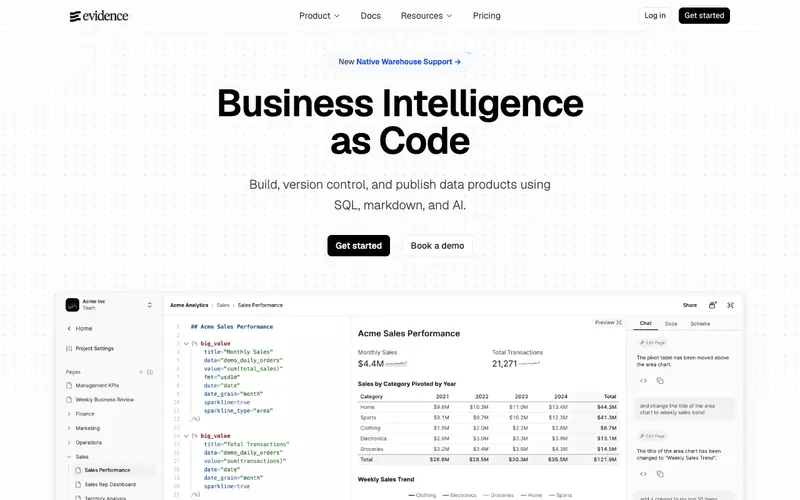
Evidence is an open-source, code-based business intelligence tool that allows data professionals to build and deploy data-driven reports and dashboards using SQL and Markdown. Its core feature is a unique workflow where users write SQL queries directly within Markdown files, and Evidence automatically renders the query results into tables, charts, or prose, creating dynamic, version-controlled reports. It was built for data analysts, data engineers, and BI developers who prefer to work with code, want to version control their reports, and integrate them into existing data workflows. Users typically open Evidence when they need to create reproducible, shareable, and living data reports that combine narrative explanations with up-to-date data visualizations. It connects to various databases via JDBC and integrates with Git for version control.
Editorial check
How this page is checked
Source trail
evidence.dev
External links are separated from Surfaced commentary.
Reader safety
Context before clicks
Product links and external services are not presented as guarantees.
Monetization
No affiliate flag
Ads and commerce links are kept distinct from editorial text.
Surfaced take
Why It’s Useful
Unlike traditional drag-and-drop BI tools that can lead to "dashboard sprawl" and lack version control, Evidence brings a developer-first approach, treating reports as code, which promotes maintainability and collaboration. For the data analyst who needs to regularly publish a sales performance report, Evidence allows them to define their queries and narrative in a single, version-controlled file, ensuring consistency. For the data team needing to document their data models and key metrics, Evidence provides a living data dictionary that updates automatically with new data. Evidence is completely free and open-source. A powerful but often overlooked feature is its automatic caching of SQL query results, which dramatically speeds up report rendering during development and deployment, especially for complex queries. It's not more popular because its code-first approach requires a comfort level with SQL and Markdown, which can be a barrier for non-technical users accustomed to GUI-based tools. Evidence has an active community on Discord and GitHub, with a strong focus on documentation and continuous improvement.
In everyday life
When you’d actually reach for this
You need to quickly share updated sales figures with your team before a client meeting. Or maybe you're finally getting around to summarizing those articles you saved, wanting to embed your findings visually. You might also want to track your personal spending trends over the last quarter in a clear, digestible format.






Enjoyed this? Get five picks like this every morning.
Free daily newsletter — zero spam, unsubscribe anytime.