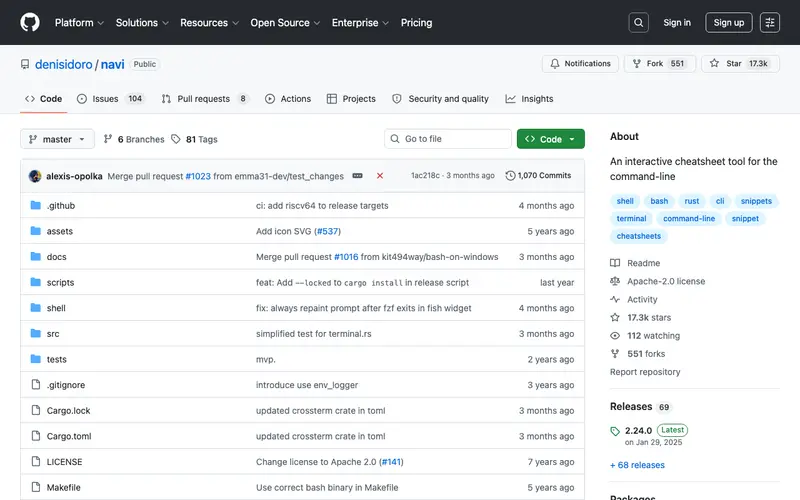
navi is an open-source interactive cheatsheet tool for the command line, written in Rust by Denis Akhiyarov. Its core feature is to store and retrieve commonly used commands and their explanations, providing an interactive fuzzy search interface. It's primarily designed for developers, system administrators, and anyone who frequently uses the terminal but struggles to remember complex command-line syntax or obscure flags. Users typically open navi when they need a quick reminder on how to perform a specific task, like creating a Git alias, managing Docker containers, or converting video files, without leaving the terminal. It works on Linux, macOS, and Windows.
Editorial check
How this page is checked
Source trail
github.com
External links are separated from Surfaced commentary.
Reader safety
Context before clicks
Product links and external services are not presented as guarantees.
Monetization
No affiliate flag
Ads and commerce links are kept distinct from editorial text.
Surfaced take
Why It’s Useful
Unlike `man` pages that are exhaustive or `tldr` that gives examples without context, navi allows users to define their own context-rich cheatsheets, making it a personalized and highly efficient memory aid. For the new developer learning `kubectl`, navi can provide pre-filled commands with placeholders for context-specific values, streamlining their learning curve. For the experienced DevOps engineer managing diverse systems, navi acts as a personalized knowledge base for obscure commands and their arguments. navi is completely free and open-source. A less obvious but powerful feature is its ability to pull cheatsheets from remote Git repositories, allowing teams to share and maintain a collective knowledge base of commands. Its niche focus on personal command management means it's often overlooked in favor of general documentation tools or raw memory. The project is actively developed on GitHub with a growing community contributing both to the tool and shared cheatsheets.





Enjoyed this? Get five picks like this every morning.
Free daily newsletter — zero spam, unsubscribe anytime.