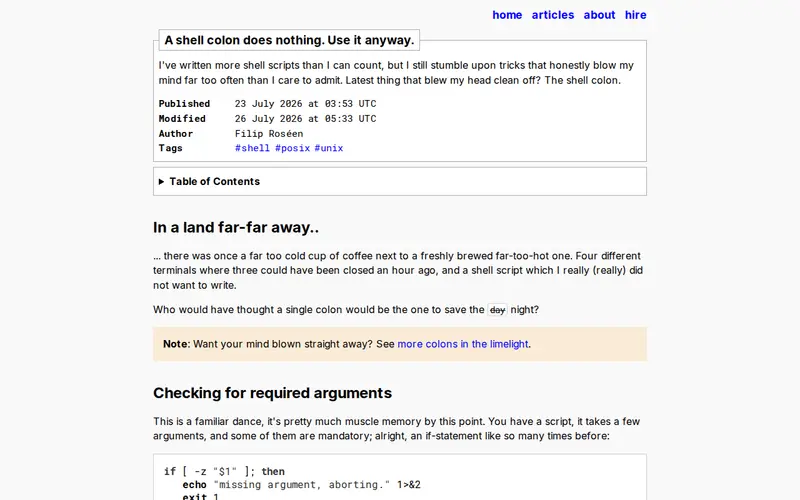
This article explores a little-known but surprisingly useful feature of Unix-like shells: the colon (:) as a no-op command. It explains how this simple character can be leveraged in shell scripting and command-line operations for various purposes, such as creating empty variables, setting default values, or providing conditional logic without executing any actual action. The author, refrp, details practical use cases that can streamline scripting and improve code readability for experienced shell users.
Editorial check
How this page is checked
Source trail
refp.se
External links are separated from Surfaced commentary.
Reader safety
Context before clicks
Product links and external services are not presented as guarantees.
Monetization
No affiliate flag
Ads and commerce links are kept distinct from editorial text.
Surfaced take
Why It’s Useful
While seemingly trivial, the humble colon in a shell environment is a powerful, overlooked tool for developers and system administrators. This article shines a light on its versatility, showcasing how it can be used for elegant variable assignment, conditional logic, and creating placeholder commands that don't affect system state. For those who spend significant time in the terminal, understanding and utilizing the colon can lead to more concise, efficient, and robust shell scripts. It's a prime example of how deep knowledge of command-line fundamentals can unlock subtle but impactful productivity gains, making it a must-read for shell enthusiasts looking to refine their craft.
In everyday life
When you’d actually reach for this
When setting up a temporary variable for a Sunday budget script, or when you need to mark a placeholder in a group trip itinerary. You might use it to create a quick, empty entry in a to-do list before handing over tasks before annual leave.







Enjoyed this? Get five picks like this every morning.
Free daily newsletter — zero spam, unsubscribe anytime.