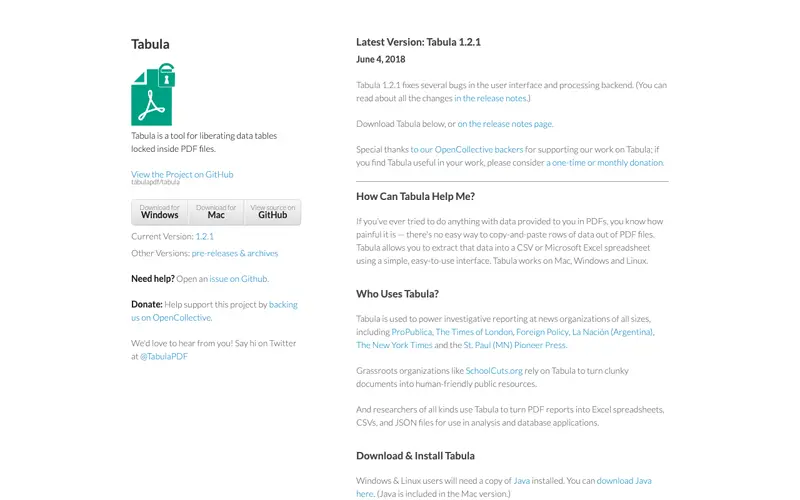
Tabula is a free and open-source tool developed by The New York Times' investigative journalism team, now maintained by a community, designed to liberate data trapped inside PDF files. Its core feature allows users to select tables within a PDF document and extract them into a structured format like CSV or Excel, overcoming the common challenge of non-selectable or uncopyable data. This tool was primarily built for journalists, researchers, and data analysts who frequently encounter data embedded in PDF reports or scanned documents. Someone typically opens Tabula when they receive a government report, academic paper, or financial statement in PDF format that contains crucial tabular data they need to analyze but cannot easily copy-paste. Being a desktop application, it works locally and exports directly to CSV, TSV, or JSON, without needing external integrations.
Editorial check
How this page is checked
Source trail
tabula.technology
External links are separated from Surfaced commentary.
Reader safety
Context before clicks
Product links and external services are not presented as guarantees.
Monetization
No affiliate flag
Ads and commerce links are kept distinct from editorial text.
Surfaced take
Why It’s Useful
While commercial tools like Adobe Acrobat Pro offer some PDF data extraction, Tabula excels specifically at accurately identifying and extracting tabular data, often outperforming proprietary solutions for complex table layouts. For the investigative journalist sifting through budget reports, it transforms static figures into actionable spreadsheets for analysis, saving countless hours of manual data entry. For the academic researcher analyzing supplementary data from published papers, it quickly converts appendix tables into a usable format for statistical software. Tabula is entirely free and open-source, maintained by a dedicated community. A lesser-known but powerful feature is its ability to define custom table areas using 'stream' or 'lattice' modes, which users often discover after realizing standard selection isn't enough for highly complex tables. It remains a hidden gem primarily because it solves a very specific, albeit common, problem, and its open-source nature means less marketing than commercial alternatives. The project has an active GitHub community and receives periodic updates to improve extraction algorithms.





Enjoyed this? Get five picks like this every morning.
Free daily newsletter — zero spam, unsubscribe anytime.