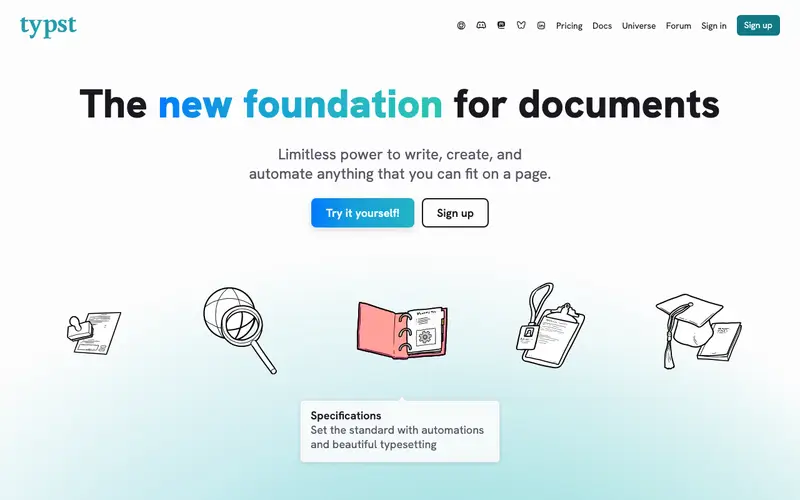
Typst is a new, open-source typesetting system developed by a small team, designed to be a modern alternative to LaTeX for scientific and technical documents. Its core feature allows users to write academic papers, reports, and presentations using a concise, intuitive markup syntax that feels like a blend of Markdown and a programming language, compiling to high-quality PDFs almost instantly. It was primarily built for academics, students, engineers, and anyone who needs to produce professional-looking documents with complex mathematical formulas, figures, and bibliographies without the steep learning curve of traditional typesetting. Users typically turn to Typst when they are frustrated with LaTeX's verbosity and slow compilation or Markdown's lack of advanced formatting for scientific content. Typst can be used via its web app or a local compiler, and it can import raw data for plotting or embed other assets.
Editorial check
How this page is checked
Source trail
typst.app
External links are separated from Surfaced commentary.
Reader safety
Context before clicks
Product links and external services are not presented as guarantees.
Monetization
No affiliate flag
Ads and commerce links are kept distinct from editorial text.
Surfaced take
Why It’s Useful
While LaTeX offers unparalleled control for scientific typesetting, Typst provides a significantly more user-friendly and faster experience, reducing the barrier to entry for producing beautiful, complex documents without sacrificing quality. For the physics graduate student writing their thesis, it dramatically cuts down compilation times and simplifies the process of creating complex equations and figures, allowing more focus on content. For an engineering team drafting technical reports, it ensures consistent professional formatting across all documents with minimal effort, making collaboration smoother. Typst offers a free web editor and a free-to-use open-source compiler, with potential future premium features for collaborative editing. A powerful, often underappreciated feature is its 'show' rules, which allow users to define custom styles and layouts for elements like headings or equations globally with minimal code, a gem discovered after mastering the basics. It's not yet more popular because it's a relatively new system competing with deeply entrenched tools like LaTeX and Word, and many are unaware of its existence. Typst has a rapidly growing community, an active GitHub repository, and frequent development updates.





Enjoyed this? Get five picks like this every morning.
Free daily newsletter — zero spam, unsubscribe anytime.