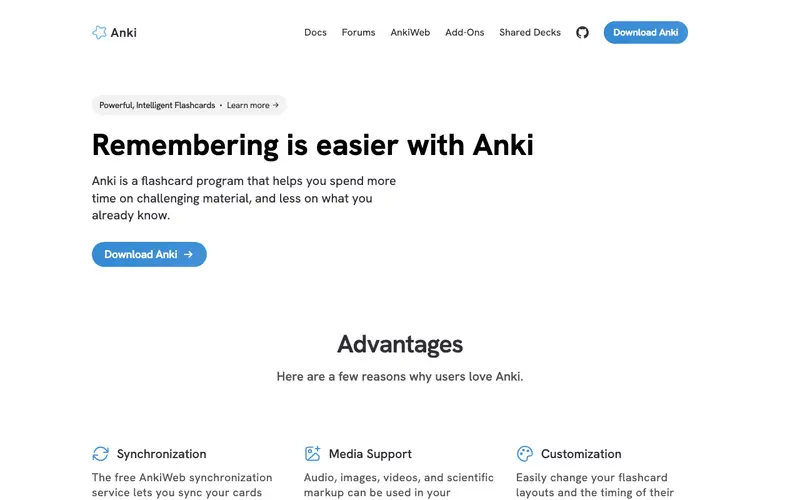
Anki, an open-source program developed by Damien Elmes, is a powerful spaced repetition flashcard system designed to help users memorize facts efficiently and permanently. It intelligently schedules reviews of information based on how well you remember it, ensuring difficult items are seen more often and easy items less frequently. The primary workflow involves creating custom flashcard decks or importing shared ones, then reviewing them daily as prompted by Anki's algorithm. It is available on Windows, Mac, Linux, Android (AnkiDroid), iOS (AnkiMobile), and as a web-based client (AnkiWeb). Data is stored locally on your device but can be synchronized across all platforms via AnkiWeb, a free cloud service provided by the developer.
Editorial check
How this page is checked
Source trail
apps.ankiweb.net
External links are separated from Surfaced commentary.
Reader safety
Context before clicks
Product links and external services are not presented as guarantees.
Monetization
No affiliate flag
Ads and commerce links are kept distinct from editorial text.
Surfaced take
Why It’s Useful
Anki fundamentally solves the problem of forgetting information over time, especially when learning complex subjects or new languages. For a medical student, it's indispensable for memorizing vast amounts of anatomical terms, drug names, and physiological processes, ensuring retention for exams and clinical practice. A language learner can create flashcards for vocabulary and grammar, using images and audio to enhance recall and improve fluency. Anki is entirely free and open-source for desktop and Android, with AnkiMobile for iOS being a paid app, but the free options are fully functional and robust. It outperforms generic flashcard apps by implementing a sophisticated, evidence-based spaced repetition algorithm, leading to superior long-term retention compared to rote memorization. The ability to use add-ons for enhanced functionality, like image occlusion or cloze deletions, is a significant power feature. Setting up basic decks and reviewing takes less than 5 minutes for a non-technical person, though advanced customization requires some learning.




Enjoyed this? Get five picks like this every morning.
Free daily newsletter — zero spam, unsubscribe anytime.