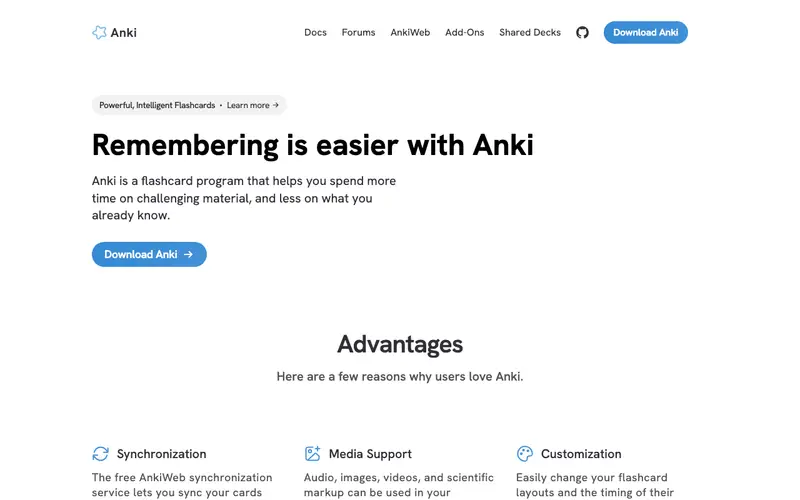
Anki is a powerful, open-source spaced repetition flashcard program developed by Damien Elmes. Its core feature is using an algorithm to optimize the timing of flashcard reviews, showing you cards just before you're about to forget them, maximizing retention with minimal effort. It was primarily built for students, language learners, and anyone needing to memorize large amounts of information efficiently. Users typically open Anki after studying new material to create cards, or daily for quick review sessions to solidify their knowledge. Anki is highly extensible with add-ons and works across Windows, macOS, Linux, Android, iOS (via AnkiMobile), and as a web client (AnkiWeb).
Editorial check
How this page is checked
Source trail
apps.ankiweb.net
External links are separated from Surfaced commentary.
Reader safety
Context before clicks
Product links and external services are not presented as guarantees.
Monetization
No affiliate flag
Ads and commerce links are kept distinct from editorial text.
Surfaced take
Why It’s Useful
While traditional flashcards or apps like Quizlet help with memorization, Anki's intelligent scheduling algorithm makes it far superior for long-term retention by focusing on active recall and spaced repetition. For the medical student overwhelmed with anatomy, Anki transforms daunting facts into manageable daily reviews, ensuring they don't forget crucial information. For the polyglot learning a new language, it efficiently embeds new vocabulary and grammar rules into their long-term memory. The desktop version is fully free and open-source, with mobile apps being paid (AnkiMobile for iOS) or free (AnkiDroid for Android). A powerful but often overlooked feature is the ability to customize review intervals and learning steps for different types of material. Its steep learning curve for optimal setup and its minimalist interface often deter new users, making it less popular than visually appealing, less effective alternatives. Anki boasts a massive community creating and sharing add-ons and decks, with frequent updates to the core software.






Enjoyed this? Get five picks like this every morning.
Free daily newsletter — zero spam, unsubscribe anytime.