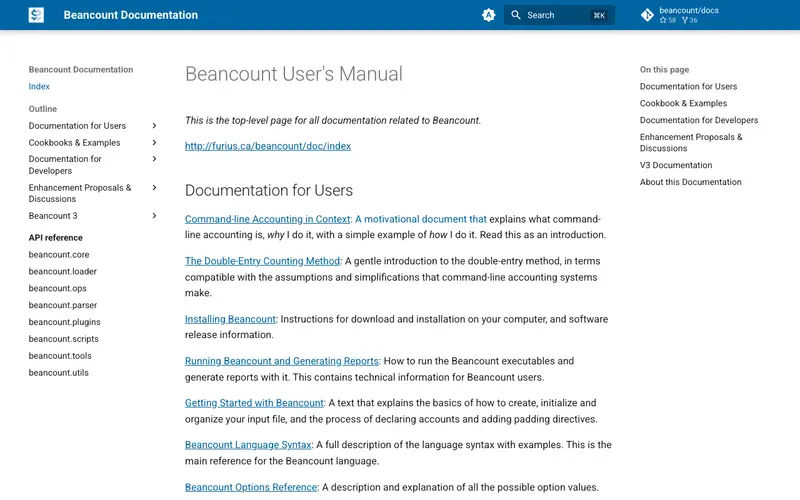
Beancount is a double-entry accounting system that uses plain text files as its data source, developed by Martin Blais, an individual contributor. It allows users to meticulously track all financial transactions, assets, and liabilities using a human-readable text format, which can then be queried and reported on. This tool is specifically designed for technically-minded individuals, developers, or anyone who prefers version control, scriptability, and full data ownership over GUI-based financial software. Users typically interact with Beancount by adding new transactions to their `.bean` files, often after bank statement reconciliation or significant financial events, then running command-line tools for reports. Being a plain-text system, it integrates seamlessly with standard developer tools like Git for version control and any text editor; plugins exist for Emacs, Vim, and VS Code.
Editorial check
How this page is checked
Source trail
beancount.github.io
External links are separated from Surfaced commentary.
Reader safety
Context before clicks
Product links and external services are not presented as guarantees.
Monetization
No affiliate flag
Ads and commerce links are kept distinct from editorial text.
Surfaced take
Why It’s Useful
Beancount replaces or complements complex spreadsheet setups and traditional accounting software like Quicken, offering unparalleled flexibility, auditability, and scriptability for financial data. For the software engineer who wants to manage their personal finances with the same rigor and tooling they use for code, Beancount offers a powerful, version-controlled solution. An academic researcher or data scientist could use Beancount to model complex financial scenarios, leveraging its powerful query language and integration with Python for advanced analysis. Beancount is entirely free and open-source, maintained by its creator and a community of contributors. A powerful, often underutilized feature is its "inferred postings" and "balance assertions," which automate categorization and proactively flag discrepancies, saving significant time during reconciliation. Its steep initial learning curve, requiring familiarity with command-line interfaces and double-entry accounting principles, makes it inaccessible to the average user. The community is primarily found in its Google Groups forum and various developer-focused subreddits, with consistent updates and a stable codebase due to its mature design.







Enjoyed this? Get five picks like this every morning.
Free daily newsletter — zero spam, unsubscribe anytime.