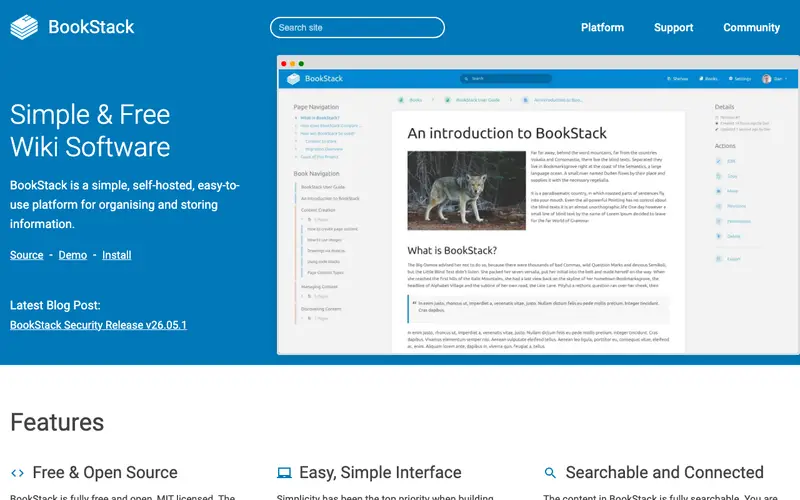
BookStack is a free and open-source platform for organizing and storing documentation, built by Dan Brown, designed to be a simple and opinionated wiki-like system. It allows users to create structured content in a book-shelf-chapter-page hierarchy, providing an intuitive way to build knowledge bases or product documentation. The primary users are small teams, open-source projects, and individuals who need a self-hosted, easy-to-manage solution for their internal or external documentation. It's typically opened when a team member needs to write a new guide, update a policy, or reference an existing procedure, serving as a central hub for organizational knowledge. BookStack is a web-based application, deployed on a server running PHP and MySQL/MariaDB, and can integrate with LDAP or SAML for user authentication.
Editorial check
How this page is checked
Source trail
bookstackapp.com
External links are separated from Surfaced commentary.
Reader safety
Context before clicks
Product links and external services are not presented as guarantees.
Monetization
No affiliate flag
Ads and commerce links are kept distinct from editorial text.
Surfaced take
Why It’s Useful
BookStack serves as an excellent open-source alternative to proprietary knowledge base tools like Confluence or Notion, offering a straightforward, self-hostable solution with a clear content hierarchy, often preferred for its simplicity over feature bloat. For the growing startup, it provides a clean and accessible platform for onboarding new employees with company policies, development guidelines, and FAQs, without incurring per-user costs. For the open-source project maintainer, it's ideal for hosting detailed project documentation, tutorials, and API references, ensuring all collaborators have easy access to up-to-date information. BookStack is entirely free and open-source, requiring only a compatible server environment to run. A feature often appreciated after initial setup is its robust revision history and page comparison tool, allowing users to track changes and revert to previous versions effortlessly. Its relative lack of mainstream recognition stems from it being a self-hosted solution, requiring some technical setup, and a focus on functionality over extensive marketing. BookStack has an active GitHub community, receives regular updates, and offers a straightforward API for custom integrations.







Enjoyed this? Get five picks like this every morning.
Free daily newsletter — zero spam, unsubscribe anytime.