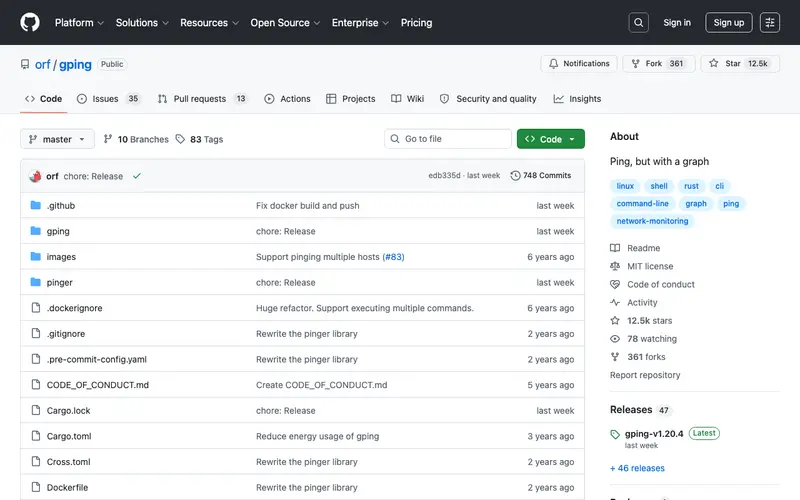
gping is an open-source command-line utility, written in Rust, that offers a unique approach to network diagnostics by visualizing `ping` results. Its core functionality is to send ICMP echo requests to a target host and display the round-trip times as a real-time, ASCII-art graph directly in the terminal. This tool is primarily built for network engineers, developers, and anyone who needs to visually monitor network latency and stability over time. A user would launch gping when they suspect intermittent network issues, want to compare latency to multiple hosts simultaneously, or simply prefer a visual representation of network performance. It runs on Linux, macOS, and Windows, making it widely accessible.
Editorial check
How this page is checked
Source trail
github.com
External links are separated from Surfaced commentary.
Reader safety
Context before clicks
Product links and external services are not presented as guarantees.
Monetization
No affiliate flag
Ads and commerce links are kept distinct from editorial text.
Surfaced take
Why It’s Useful
gping dramatically improves upon the standard `ping` command by offering an immediate visual context for latency fluctuations, making it easier to spot trends or sudden drops. For the developer troubleshooting a slow API endpoint, gping can quickly show if the problem lies with network latency to the server rather than the application itself. For the gamer experiencing lag spikes, it provides a clear, real-time graph to confirm and track network instability. gping is entirely free and open-source. A powerful but often undiscovered feature is its ability to ping multiple hosts simultaneously and display their graphs in parallel, allowing for direct comparison of network performance to different destinations. Its relative obscurity compared to the ubiquitous `ping` command is primarily due to users being unaware of a graphical alternative that exists directly in the terminal. The project is actively developed on GitHub, with ongoing improvements and community contributions.
In everyday life
When you’d actually reach for this
You're trying to figure out why your video call is stuttering during a team sync. You're also checking if the office Wi-Fi is acting up before you hand off urgent tasks before going on holiday.





Enjoyed this? Get five picks like this every morning.
Free daily newsletter — zero spam, unsubscribe anytime.