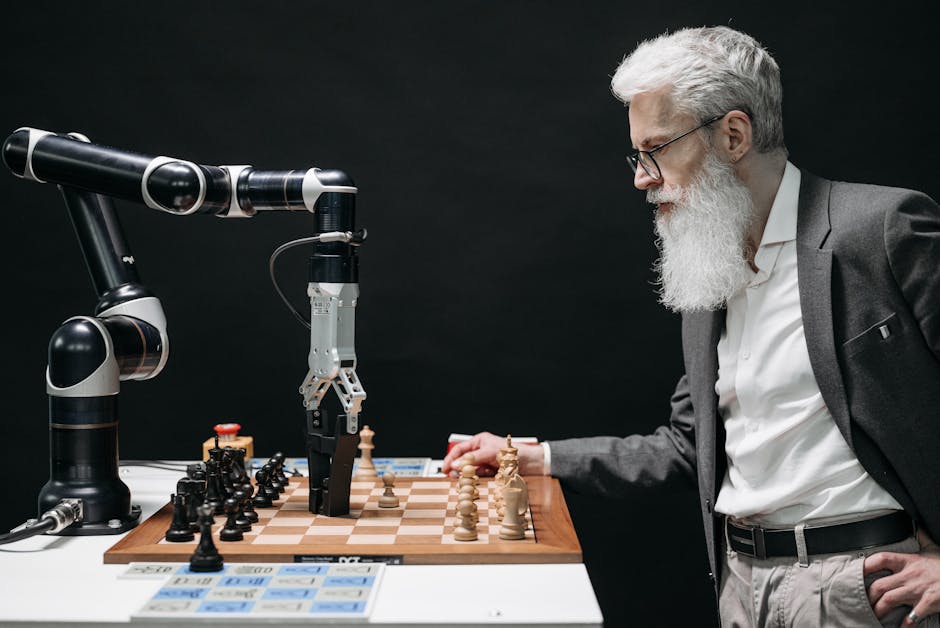
Photo via Pexels
Human-Centric Predictive Motion Planning via Reinforcement Learning (RL) involves training autonomous vehicles to anticipate and react to human road users' likely future actions by observing their behavior patterns and applying learned policies. Instead of just reacting to immediate sensor data, RL models learn from vast amounts of driving data and simulations to predict trajectories and intentions, enabling smoother, more human-like, and safer interactions. Companies like Waymo, Cruise, and Pony.ai are heavily investing in RL-based prediction and planning modules to enhance their autonomous driving stacks. This technology is currently in advanced research and integration into early commercial robotaxi fleets, with Waymo's 2023 'Optimizing the Prediction Stack for Autonomous Driving' paper showcasing improved prediction accuracy. This approach yields more natural and predictable driving behavior compared to purely rule-based or classical control algorithms, which often struggle with complex social interactions.
Editorial check
How this page is checked
Source trail
ai.stanford.edu
External links are separated from Surfaced commentary.
Reader safety
Context before clicks
Product links and external services are not presented as guarantees.
Monetization
No affiliate flag
Ads and commerce links are kept distinct from editorial text.
Surfaced take
Why It Matters
Current autonomous vehicles can sometimes drive overly cautiously or unpredictably around human drivers and pedestrians, leading to frustration, inefficient traffic flow, and hindering social acceptance, impacting a global autonomous driving software market estimated at $15 billion by 2025. With human-centric RL, robotaxis will seamlessly integrate into diverse traffic environments, exhibiting intuitive and trustworthy driving behavior that fosters public confidence and accelerates adoption, making urban travel more fluid and less stressful. Companies with superior RL training data and simulation environments will win, while those relying on simpler prediction models may lag; human drivers will experience less friction with AVs. Technical hurdles include developing robust, explainable RL models that generalize well to novel scenarios and ensuring their safety certification without extensive real-world testing. Expect this to mature in Level 4 robotaxis by 2027-2030, with strong competition from US tech giants and Chinese startups. A second-order consequence is that the insights gained from modeling human driving behavior could be used to train human drivers more effectively, or even design safer road infrastructure that intrinsically guides drivers towards optimal interactions with AVs.
Development Stage
Related

Empathizer
Empathizer is an innovative application designed to enhance social understanding by analyzing communication patterns and providing insights into emotional…
Gleam
Gleam is an open-source, interactive data visualization tool developed by Google that enables rapid exploration of large datasets directly in your web browser…
Enjoyed this? Get five picks like this every morning.
Free daily newsletter — zero spam, unsubscribe anytime.