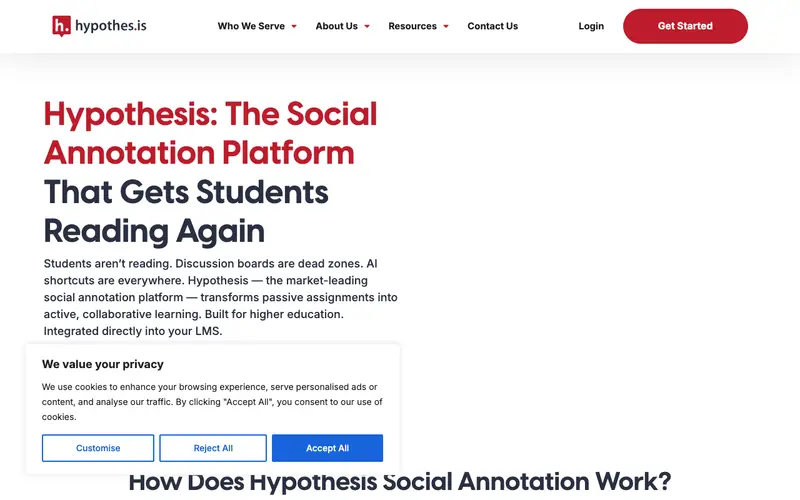
Hypothesis is an open-source project and non-profit organization dedicated to enabling collaborative annotation on the web. Its core feature allows users to add notes and highlights to any web page or PDF document, creating a layer of discussion directly on top of the content. This tool was primarily built for educators, researchers, and students to facilitate critical reading, peer feedback, and collective understanding of online texts. Someone typically installs the browser extension or uses the web app when they need to discuss a research paper, article, or online textbook with colleagues or students, or simply make private annotations for themselves. Hypothesis integrates seamlessly with learning management systems like Canvas and Moodle, and also works with local PDFs when uploaded to its server.
Editorial check
How this page is checked
Source trail
web.hypothes.is
External links are separated from Surfaced commentary.
Reader safety
Context before clicks
Product links and external services are not presented as guarantees.
Monetization
No affiliate flag
Ads and commerce links are kept distinct from editorial text.
Surfaced take
Why It’s Useful
Unlike traditional document editors or standalone note-taking apps, Hypothesis embeds annotation directly onto the web, allowing for contextual discussions that stay with the content, making it a superior tool for active reading and collaborative learning. For the university lecturer assigning a complex research article, it enables students to highlight confusing passages and collectively ask questions, fostering deeper engagement. For a research team reviewing a draft manuscript hosted online, it provides a centralized platform for precise, line-by-line feedback without emailing multiple versions. The core annotation service is entirely free and open-source, sustained by grants and institutional partnerships. A powerful, often underutilized feature is the ability to create private or group-specific annotation layers, allowing for focused discussions within defined communities, a gem discovered by users after initial public annotations. Its open-source, non-profit nature means it relies on grassroots adoption and institutional partnerships rather than aggressive marketing, limiting its broader visibility. Hypothesis boasts a vibrant community, extensive documentation, and regular updates to its browser extensions and backend services.







Enjoyed this? Get five picks like this every morning.
Free daily newsletter — zero spam, unsubscribe anytime.