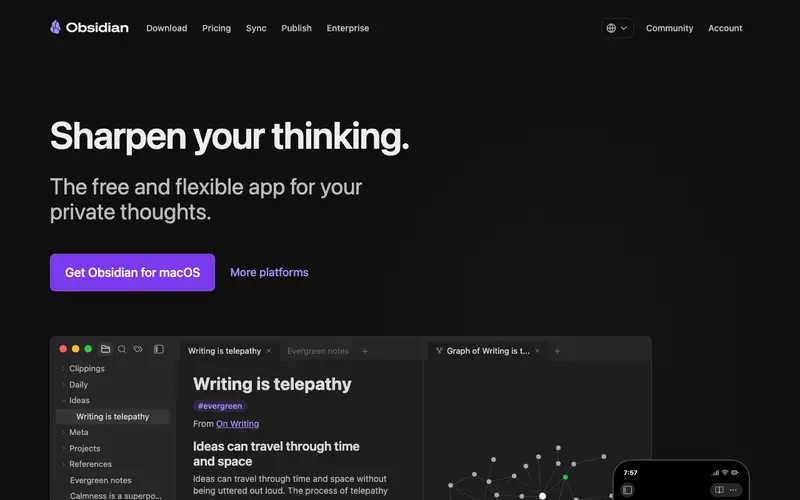
Obsidian is a powerful knowledge base on local Markdown files, developed by a small, independent company called Dynalist. Its core feature is creating a "second brain" by linking notes together using a plain text markdown format, visualized as a graph of interconnected thoughts, allowing users to build a robust personal knowledge management system. Obsidian is primarily built for researchers, writers, students, and anyone who wants to create a personalized, future-proof knowledge repository that encourages serendipitous discovery and deep thinking. Users typically open Obsidian to capture new ideas, link existing notes, or explore their knowledge graph, making connections as they go. It works with local Markdown files, offering flexibility with cloud sync solutions like Dropbox or iCloud, and is available for macOS, Windows, Linux, iOS, and Android.
Editorial check
How this page is checked
Source trail
obsidian.md
External links are separated from Surfaced commentary.
Reader safety
Context before clicks
Product links and external services are not presented as guarantees.
Monetization
No affiliate flag
Ads and commerce links are kept distinct from editorial text.
Surfaced take
Why It’s Useful
Obsidian offers a fundamentally different and more powerful approach to note-taking than linear apps like Google Docs or even hierarchical tools like Notion, by focusing on atomic notes and bidirectional linking. For the academic researcher synthesizing vast amounts of information, Obsidian's graph view and powerful linking capabilities help uncover hidden connections between concepts and sources. For the creative writer building a complex world or intricate character backstories, it provides an organic way to interlink details, ensuring consistency and sparking new ideas. Obsidian is completely free for personal use, with paid Catalyst licenses available for early access and commercial use. A truly powerful feature that many new users overlook is the vast plugin ecosystem, allowing users to customize Obsidian with features like Kanban boards, spaced repetition, and advanced data views, extending its capabilities far beyond basic note-taking. Its local-first, plain-text approach, while a huge advantage for data ownership and longevity, can be daunting for users accustomed to cloud-based, WYSIWYG editors, creating a barrier to entry. Obsidian boasts an incredibly active and supportive community, a rapidly growing plugin marketplace, and frequent core application updates.







Enjoyed this? Get five picks like this every morning.
Free daily newsletter — zero spam, unsubscribe anytime.