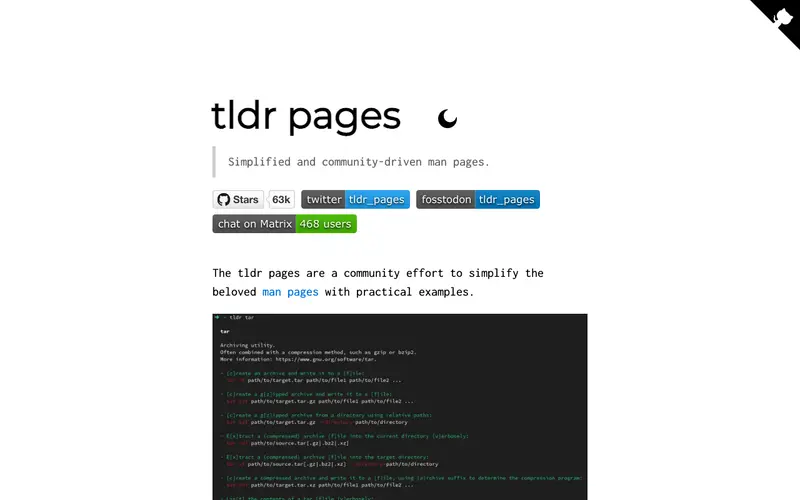
tldr is a collection of simplified and community-driven man pages, an open-source project with contributions from thousands worldwide. Its core feature is providing concise, practical examples for common command-line tools, making complex commands instantly understandable without wading through lengthy official documentation. It was created for developers, system administrators, and anyone who uses the command line but struggles with the verbosity of `man` pages or needs quick reminders. Users turn to tldr when they know *what* a command does but forget *how* to use it for a specific common task, such as archiving files or inspecting network connections. It functions as a standalone client available in various programming languages, accessible via a simple `tldr <command>` syntax.
Editorial check
How this page is checked
Source trail
tldr.sh
External links are separated from Surfaced commentary.
Reader safety
Context before clicks
Product links and external services are not presented as guarantees.
Monetization
No affiliate flag
Ads and commerce links are kept distinct from editorial text.
Surfaced take
Why It’s Useful
tldr is a vastly superior alternative to traditional `man` pages for quickly recalling command usage, as it focuses on practical examples rather than exhaustive documentation. For a developer needing to quickly `tar` a directory with specific options, tldr provides the exact command snippet in seconds, saving them from parsing a multi-page manual. A new Linux user trying to figure out `grep` can find simple, common use cases without being overwhelmed by advanced regular expressions. The tldr project and its clients are entirely free and open-source, maintained by a large community. A lesser-known feature is its support for multiple languages, allowing users to get explanations in their native tongue if available. Its primary hurdle to wider adoption is that many long-time CLI users are accustomed to `man` pages or simply Google commands, not realizing a dedicated, streamlined resource exists. It boasts a massive, active community contributing examples and clients, ensuring up-to-date and comprehensive coverage.





Enjoyed this? Get five picks like this every morning.
Free daily newsletter — zero spam, unsubscribe anytime.