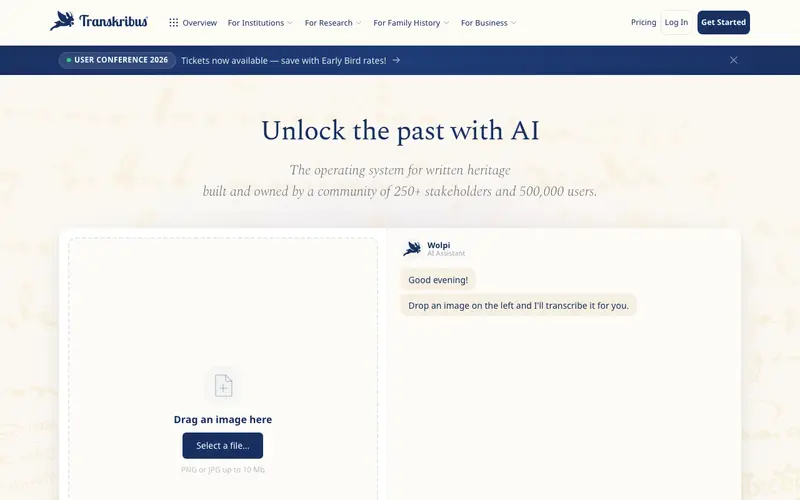
Transkribus is an AI-powered platform developed by the READ-COOP SCE, a European cooperative, for automated text recognition, specifically from historical documents. Its core feature is Hand-written Text Recognition (HTR) and Layout Analysis, which can accurately transcribe handwritten, printed, and even early modern scripts into searchable digital text. It is primarily built for researchers, archivists, historians, genealogists, and digital humanities scholars working with large volumes of historical documents. Users turn to Transkribus when they need to digitize, search, and analyze historical manuscripts, letters, or archival records that would be prohibitively time-consuming to transcribe manually. It offers a standalone desktop application and cloud-based services for model training and processing, providing flexibility for different workflows.
Editorial check
How this page is checked
Source trail
readcoop.eu
External links are separated from Surfaced commentary.
Reader safety
Context before clicks
Product links and external services are not presented as guarantees.
Monetization
No affiliate flag
Ads and commerce links are kept distinct from editorial text.
Surfaced take
Why It’s Useful
Unlike generic OCR software, Transkribus is specifically trained on diverse historical documents and handwriting styles, offering unparalleled accuracy for specialized research that traditional tools cannot handle, making it invaluable for humanities scholars. For the historian sifting through centuries-old parish registers, it allows them to quickly search and extract data that would otherwise require meticulous, manual transcription taking months or years. For the archival institution, it enables the creation of searchable digital editions of entire collections, making them accessible to a global audience and preserving cultural heritage. Users receive a free credit allowance upon registration, with additional pages requiring purchase or institutional subscriptions, balancing accessibility with sustainability. A powerful but often undiscovered feature is the ability to train your own custom HTR models for specific collections or unique handwriting styles, dramatically improving accuracy over generic models. It's not more popular because its niche application targets a specific academic and archival community, and the learning curve for advanced features can be steep for newcomers. It has a strong academic community, frequent workshops, and continuous model improvements, driven by ongoing research.






Enjoyed this? Get five picks like this every morning.
Free daily newsletter — zero spam, unsubscribe anytime.