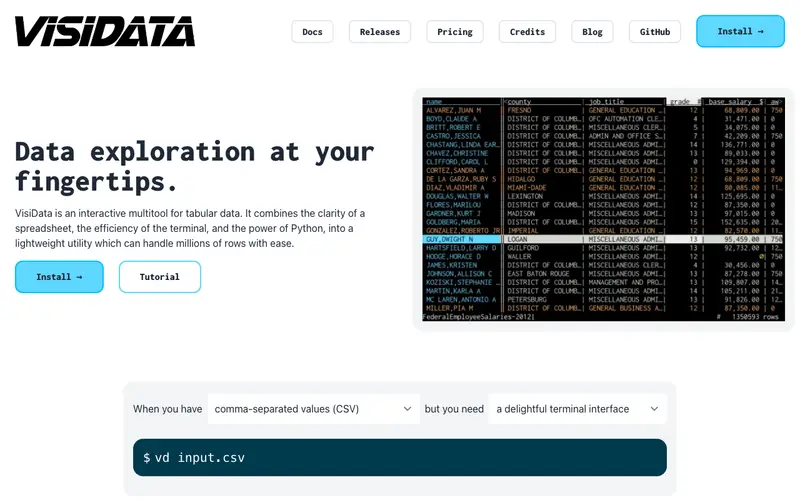
VisiData is a free and open-source command-line tool developed by Saul Pwanson, designed for quickly exploring, cleaning, and summarizing tabular data directly in the terminal. Its core feature is its spreadsheet-like interface combined with powerful, keyboard-driven commands that allow users to navigate, sort, filter, aggregate, and pivot data from various formats (CSV, TSV, Excel, JSON, HDF5, SQL databases). It's primarily built for data analysts, developers, and researchers who frequently work with structured data and prefer a fast, keyboard-centric workflow without leaving their terminal. Users typically open VisiData when they need to perform quick ad-hoc analysis on a dataset, inspect a large file, or prepare data for further processing, often as an alternative to opening a full spreadsheet program. It runs on Unix-like systems (Linux, macOS) and offers basic plotting capabilities directly within the terminal.
Editorial check
How this page is checked
Source trail
visidata.org
External links are separated from Surfaced commentary.
Reader safety
Context before clicks
Product links and external services are not presented as guarantees.
Monetization
No affiliate flag
Ads and commerce links are kept distinct from editorial text.
Surfaced take
Why It’s Useful
VisiData offers a significantly faster and more efficient way to interact with data compared to opening large CSVs in Excel or writing complex scripts, especially for quick exploratory analysis. For the DevOps engineer debugging logs, VisiData allows for rapid filtering and aggregation of large text files to pinpoint issues without parsing them into a database. For the data scientist needing to quickly survey a new dataset's distributions and missing values, VisiData provides instant insights that would take longer in Python/Pandas for initial exploration. It is entirely free and open-source, emphasizing privacy as data never leaves your local machine. A powerful feature often discovered later is its ability to define custom Python expressions for columns, allowing for complex transformations on the fly. Its command-line nature and reliance on keyboard shortcuts make it less popular with GUI-centric users, despite its immense power for those comfortable in the terminal. VisiData has an active maintainer, a dedicated community on GitHub, and regular updates with new features and format support.





Enjoyed this? Get five picks like this every morning.
Free daily newsletter — zero spam, unsubscribe anytime.