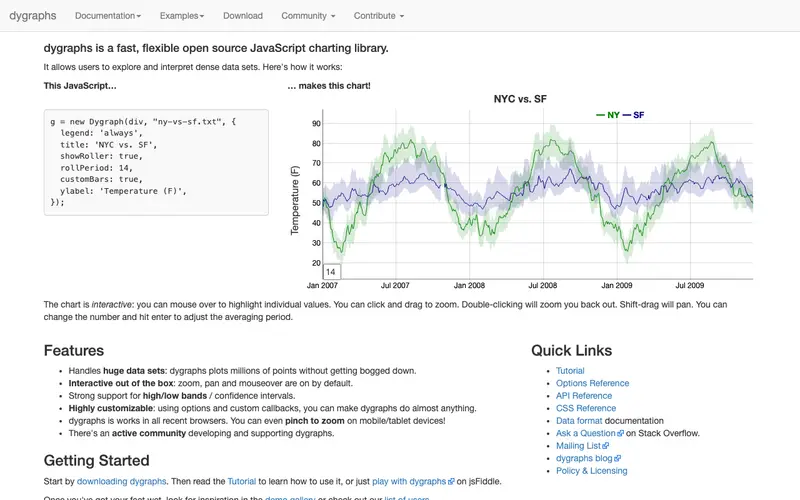
dygraphs is an open-source JavaScript charting library developed by Dan Vanderkam and a community of contributors, specifically designed for displaying large datasets of time-series data. Its core feature is its ability to handle millions of data points with high performance, offering interactive pan, zoom, and data point inspection capabilities directly in the browser. It's primarily built for data scientists, engineers, and web developers who need to visualize scientific, financial, or sensor data that changes over time. Developers typically integrate dygraphs into web applications when they require robust, interactive time-series plots that can gracefully handle vast amounts of data without performance degradation. It integrates well with standard web technologies, can load data from CSV, arrays, or custom data sources, and supports various integrations like annotations and range selectors.
Editorial check
How this page is checked
Source trail
dygraphs.com
External links are separated from Surfaced commentary.
Reader safety
Context before clicks
Product links and external services are not presented as guarantees.
Monetization
No affiliate flag
Ads and commerce links are kept distinct from editorial text.
Surfaced take
Why It’s Useful
dygraphs provides a highly performant and interactive solution for time-series data visualization, often outperforming more general-purpose charting libraries like Chart.js or D3.js when dealing with very large datasets. For the financial analyst building a dashboard to visualize decades of stock market data, dygraphs offers smooth zooming and panning that keeps the user engaged without lag. For the IoT engineer monitoring real-time sensor data from thousands of devices, it provides a reliable way to display and interact with continuous data streams efficiently. It is completely free and open-source, making it ideal for both personal projects and enterprise solutions. A hidden gem is its 'synchronization' feature, allowing multiple dygraphs charts on a page to pan and zoom together, perfect for comparing related time series. Its specialized focus on time series and reliance on JavaScript development make it less known among general users, who might opt for simpler charting tools, but its capabilities are essential for big data. The project is actively maintained on GitHub, benefiting from community contributions and regular updates.







Enjoyed this? Get five picks like this every morning.
Free daily newsletter — zero spam, unsubscribe anytime.