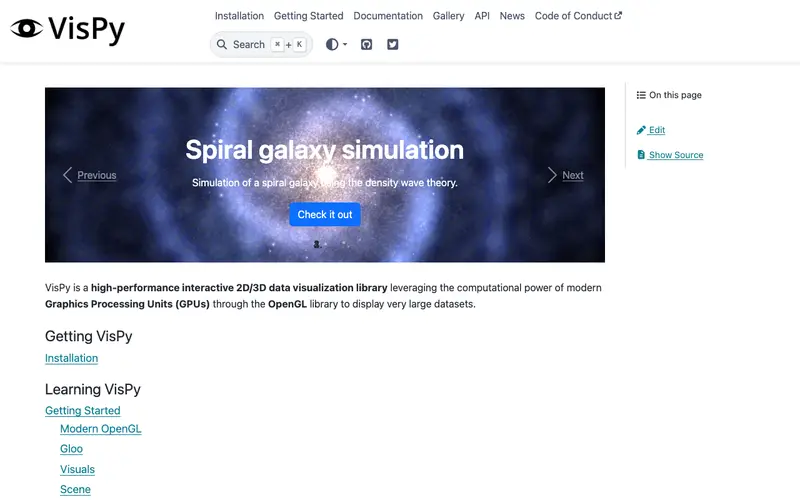
VisPy is an open-source, high-performance interactive 2D/3D visualization library for Python, leveraging OpenGL for hardware-accelerated rendering. Its core feature allows Python developers and scientists to create fast, interactive plots and scientific visualizations, particularly suited for large and dynamic datasets, by directly utilizing the GPU. It was built for researchers, engineers, and scientists working with complex data like microscopy images, neural activity, or simulation results, who need real-time interaction and high frame rates. Users typically open VisPy when they are developing a scientific application in Python and require extreme performance for visualizing evolving data or complex 3D models. It integrates deeply with NumPy for data handling and can be embedded into various GUI toolkits like PyQt, PySide, or WxPython.
Editorial check
How this page is checked
Source trail
vispy.org
External links are separated from Surfaced commentary.
Reader safety
Context before clicks
Product links and external services are not presented as guarantees.
Monetization
No affiliate flag
Ads and commerce links are kept distinct from editorial text.
Surfaced take
Why It’s Useful
While Matplotlib is a staple for Python plotting, VisPy offers orders of magnitude faster rendering for truly massive or real-time datasets, making interactive exploration feasible where other libraries would lag. For the neuroscientist analyzing gigabytes of brain activity data, VisPy enables real-time visualization of neuron spikes and network dynamics in 3D. For the physicist simulating complex fluid dynamics, VisPy provides the capability to render and interact with high-resolution 3D models as they evolve, without compromising performance. VisPy is entirely free and open-source. A particularly powerful but often undiscovered feature is its flexible GLSL shader system, allowing advanced users to write custom GPU-accelerated rendering pipelines for highly specialized visualizations. It's not more popular because it targets a very specific niche of high-performance scientific visualization and has a steeper learning curve due to its OpenGL foundation, unlike higher-level plotting libraries. The project is actively maintained on GitHub by a dedicated community of scientific Python developers.
In everyday life
When you’d actually reach for this
You might reach for VisPy when trying to visualize complex financial data for your personal budget. It could also be useful for creating interactive maps to plan a group trip with friends.







Enjoyed this? Get five picks like this every morning.
Free daily newsletter — zero spam, unsubscribe anytime.