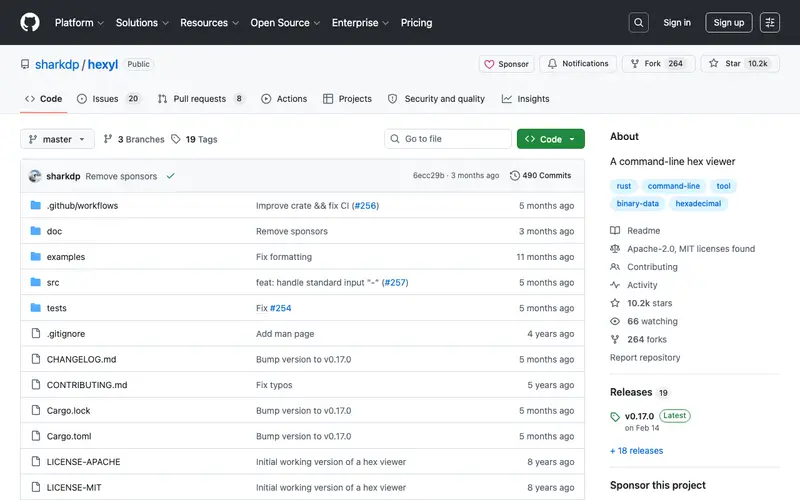
hexyl is an open-source command-line hex viewer, crafted in Rust, that provides a beautifully formatted, colorized display of binary data. Its core feature is to present file contents in hexadecimal, decimal, and ASCII representations, making it easy to inspect raw data, identify patterns, and debug binary files. This utility is primarily aimed at developers, reverse engineers, security researchers, and anyone needing to peer into the low-level structure of files. A user would invoke hexyl when they suspect corruption in a file, need to understand a specific file format, or debug network protocols by examining packet captures. It functions as a standalone executable on Linux, macOS, and Windows.
Editorial check
How this page is checked
Source trail
github.com
External links are separated from Surfaced commentary.
Reader safety
Context before clicks
Product links and external services are not presented as guarantees.
Monetization
No affiliate flag
Ads and commerce links are kept distinct from editorial text.
Surfaced take
Why It’s Useful
Unlike basic hex dumping tools, hexyl offers intelligent colorization based on byte entropy, highlighting patterns or anomalies in binary data that would otherwise be invisible. For the reverse engineer analyzing a compiled executable, hexyl's clear layout and entropy-based coloring can quickly point to code sections versus data, or encrypted regions. For the network engineer debugging a custom protocol, it allows for precise examination of packet headers and payloads. hexyl is entirely free and open-source. A less obvious feature is its ability to handle pipes (`cat binary_file | hexyl`), allowing it to be integrated into complex shell pipelines for on-the-fly inspection. Its niche functionality and the existence of many older, less user-friendly hex viewers mean it hasn't become a household name, despite its superior presentation and ease of use. The project is actively maintained on GitHub with a responsive developer.
In everyday life
When you’d actually reach for this
You're trying to figure out why a downloaded file isn't working as expected. You need to quickly check the raw bytes of a configuration file that's causing application errors. You're curious about the exact contents of a corrupted image file you found.







Enjoyed this? Get five picks like this every morning.
Free daily newsletter — zero spam, unsubscribe anytime.