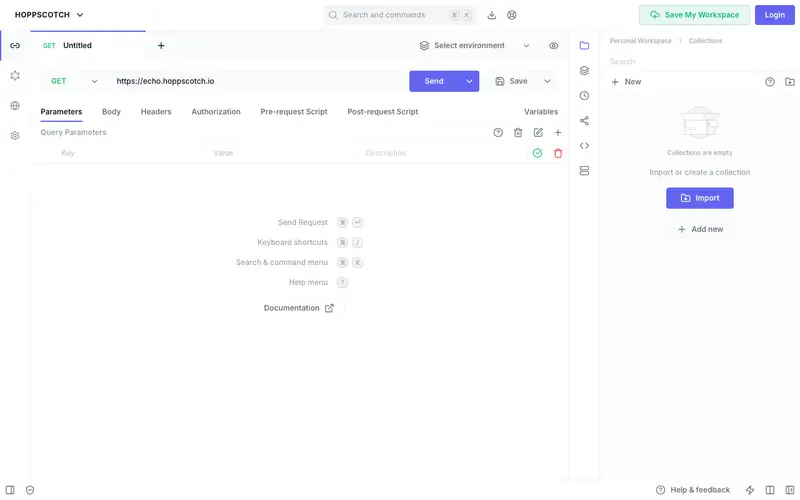
Hoppscotch, an open-source project created by Liyas Thomas and maintained by a community, is a free, fast, and beautiful API development ecosystem delivered as a web application. It functions as an alternative to Postman, allowing developers to send requests, inspect responses, and manage API collections. While primarily an API client, it includes robust features for saving and organizing code snippets related to API requests, authentication headers, and response parsing. The tool is entirely web-based, accessible via any modern browser, and also offers desktop clients for Windows, macOS, and Linux. Its most used feature is the ability to quickly test REST, GraphQL, and WebSocket APIs directly from the browser. User data, including saved requests and snippets, can be synchronized to the cloud via optional login or stored locally in the browser's indexedDB for privacy.
Editorial check
How this page is checked
Source trail
hoppscotch.io
External links are separated from Surfaced commentary.
Reader safety
Context before clicks
Product links and external services are not presented as guarantees.
Monetization
No affiliate flag
Ads and commerce links are kept distinct from editorial text.
Surfaced take
Why It’s Useful
Hoppscotch eliminates the need for heavyweight desktop applications or complex command-line tools for testing and developing APIs, offering a lightweight web-first approach. For the front-end developer integrating with new APIs, it provides a clean interface to test endpoints, craft request bodies, and save reusable snippets for common authentication flows. For the backend engineer designing API contracts, Hoppscotch allows for rapid prototyping and sharing of request examples with documentation, ensuring clarity for consumers. Since it's open-source and web-based, it's completely free and genuinely useful for all users, offering full functionality without any paywalls. It competes directly with Postman, winning by being open-source, lighter-weight, and often preferred by developers who value browser-native experiences and control over their data. The "environments" power feature allows users to easily switch between different API configurations (e.g., development, staging, production) by managing sets of variables, making snippet reusability much more efficient. A non-technical person might find API concepts challenging, but a developer could start sending their first request and saving a snippet in under 5 minutes.
In everyday life
When you’d actually reach for this
You're trying to understand the API for a new feature your team is building, or perhaps you're troubleshooting a connection issue with a web service you rely on. When you're passing off ongoing development work to a colleague before vacation, you'll want to ensure they can easily access and test the necessary API endpoints.





Enjoyed this? Get five picks like this every morning.
Free daily newsletter — zero spam, unsubscribe anytime.